
WhatsApp:+86 15626945905
Introduction
The global pet supply chain is undergoing a structural transformation. The days when pet owners settled for basic, single-stitch nylon webbing and flimsy plastic accessories are gone. Today’s consumers view their dogs as lifestyle partners, integrating them into high-intensity outdoor activities like alpine hiking, backcountry camping, and competitive agility training.
For brand founders and procurement managers, this consumer shift introduces a critical strategic choice. Competing on price at the low end of the market is a race to the bottom. The future of profitability and brand equity lies in the premium segment. To capture this lucrative market, global pet brands require an integrated manufacturing partner capable of executing strict, advanced production standards.
Premium vs. Commodity: The Structural B2B Differentiation
To understand why global buyers are pivoting away from cheap manufacturers, we must look at the physical and financial differences between low-grade commodities and engineered outdoor pet equipment:
| Technical Attribute | Commodity Pet Gear (Low-End Factories) | Premium Active Gear (Petop Outdoors Standard) | Brand Operational Impact |
| Core Base Fabric | Generic, thin polyester or low-denier nylon | Military-grade 600D-1000D Nylon / Heavy-duty Teslin Mesh | Eliminates tearing under heavy pull; zero fabric deformation |
| Hardware Speeds | Reclaimed zinc alloy / Standard PVC plastic | Anti-corrosion Aerospace Alloy / Reinforced POM Buckles | Passes 100% salt-spray and high-impact fracture testing |
| Stitching Matrix | Standard linear stitching; manual tension control | Programmable high-density bar-tack computerized stitching | Prevents handle snapping; reduces customer RTV rates |
| Factory Engineering | Blindly copies tech packs without warning of flaws | Active Proactive Value Engineering & Design Optimization | Shortens development cycles; maximizes your unit profit margins |
The Hidden Financial Dangers of Reactive “Order-Taking” Factories
Many sourcing managers fall into the trap of partnering with low-cost factories that act merely as passive execution machines. These facilities lack market insight, possess no engineering depth, and will blindly manufacture a blueprint even if it contains critical structural or ergonomic flaws.
When an outdoor brand relies on an inexperienced supplier, the brand bears all the financial risks:
1. High Return-to-Vendor (RTV) Rates and Bad Reviews
Weak, non-reinforced stitching at high-stress leash attachment points causes harnesses to fail in the field. For e-commerce brands and large retailers, this translates to skyrocketing return rates, negative Amazon/Shopify reviews, and eroded brand trust that takes years to rebuild.
2. Severe Liability and Product Recall Risks
A single catastrophic hardware failure—such as a cracked chest buckle or a snapped D-ring during a hike—can permanently destroy a brand’s reputation and invite legal liabilities. Reactive factories do not test the load limits of their hardware, leaving your brand exposed to safety failures.
3. Bleeding Margins Due to Poor Component Choices
An uneducated factory will often use overly complex, expensive assembly methods or heavy, non-optimized hardware just to meet a basic sketch. Without a manufacturer that understands Value Engineering, you end up overpaying for the Bill of Materials (BOM), compressing your wholesale margins.
How Premium Quality is Engineered: The Petop Outdoors Infrastructure
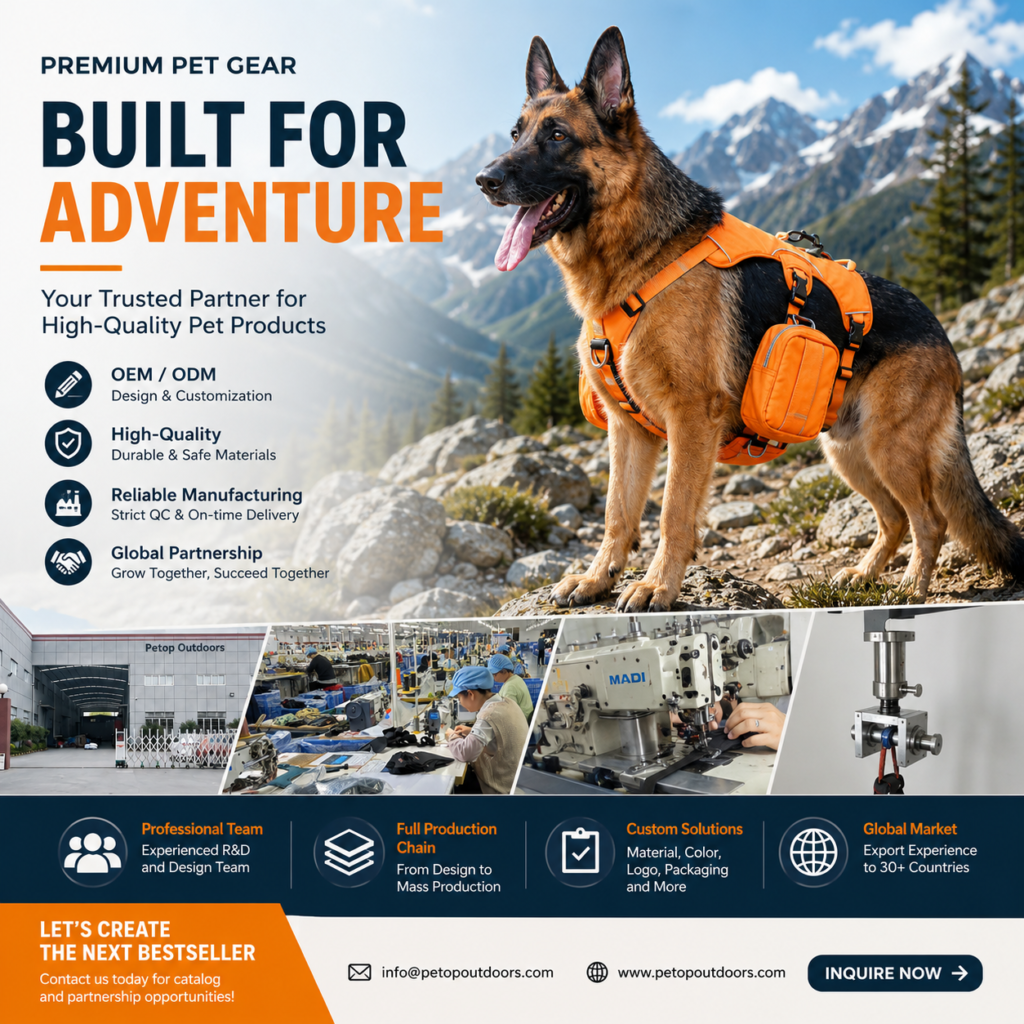
True premium quality is an industrial discipline. As an integrated source manufacturer, we embed rigorous quality controls and technical material expertise into our primary production lines, specializing in multi-functional dog harnesses and rugged outdoor dog folding beds.
Advanced Material Science for Extreme Outdoor Environments
We don’t source generic textiles. Our tactical dog harnesses are built exclusively from high-tensile 1000D nylon that resists abrasion from rocks and brush, lined with anti-chafing, breathable sandwich air mesh.
For our outdoor dog folding beds, we engineer weather-resistant, powder-coated steel or rust-proof aluminum frames paired with high-density, UV-stabilized Teslin mesh. This precise combination ensures the bed resists moisture, prevents bacterial growth, and withstands continuous cyclic weight loads without sagging.
Computerized CNC Precision and Structural Reinforcement
To eliminate human error, our factory utilizes automated computer-controlled (CNC) fabric cutting machines. CNC cutting guarantees perfectly clean edges and zero dimensional variance across bulk orders. Furthermore, every critical stress point—such as the grab handles on our harnesses or the corner mounts on our folding cots—is reinforced with automated, high-density bar-tack stitching patterns engineered to distribute pulling pressure evenly across the structure.
Secure a Resilient, Consultant-Led Supply Chain Partner
To scale a premium pet brand across North America, Europe, Australia, and expanding regional hubs like Costa Rica and the Middle East, your supply chain must be a competitive advantage, not a strategic liability.
At Petop Outdoors, we provide global brands, wholesale distributors, and retail enterprises with the specialized OEM/ODM infrastructure needed to dominate the premium market. By choosing an expert manufacturer that actively optimizes your product designs, you protect your brand equity, maximize profitability, and deliver unparalleled reliability to your end consumers.
Ready to transition your product lines to premium, factory-direct performance? Contact our B2B support team today to discuss bulk customization, value engineering options, and long-term manufacturing partnerships.
🌞 www.petopoutdoors.com
📧 info@petopoutdoors.com
📞 WhatsApp: +86 15626945905
Frequently Asked Questions (FAQ)
Q1: What is driving the high-margin premium shift in the outdoor dog gear market?
A: The market is shifting due to the rapid humanization of pets and the rise of outdoor active lifestyles among dog owners. Modern consumers actively reject cheap, single-use pet products. They demand rugged durability, safety compliance, and specialized weatherproofing, allowing premium brands to command significant price premiums and higher customer loyalty.
Q2: What technical specifications define a premium outdoor dog folding bed?
A: A premium outdoor dog bed requires an elevated architectural frame built from powder-coated, rust-resistant steel or aerospace-grade aluminum to handle outdoor moisture. The sleeping surface must utilize high-density, UV-resistant, and breathable Teslin or PVC mesh fabric, which allows optimal airflow, resists claws, and prevents odor and water accumulation.
Q3: How does active Value Engineering protect a pet brand’s profit margins?
A: Value Engineering is a proactive process where our factory engineers analyze your Tech Pack to identify structural optimizations. By modifying complicated sewing sequences or suggesting advanced alternative materials that offer the same durability at a lower cost, we help brands minimize material waste and optimize their BOM without sacrificing premium quality.
Q4: Why are automated production lines critical for manufacturing OEM dog harnesses?
A: Automated production lines—specifically CNC fabric cutters and programmable computerized stitching machines—eliminate human error. They guarantee perfect dimensional alignment, clean fabric edges that won’t fray, and uniform, high-density bar-tack reinforcement at all primary leash and handle attachment points to prevent field failure.
Q5: What are the risks of sourcing pet gear from a reactive, “order-taking” factory?
A: Reactive factories lack technical expertise and market understanding. They will blindly execute flawed blueprints without warning the client of potential structural defects. This results in high defect rates, compromised animal safety, missed delivery lead times, and ultimately, devastating product returns and recalls for your brand.
Q6: What customization (OEM/ODM) capabilities should a premium buyer look for in a direct factory?
A: Buyers should look for full-scale OEM/ODM integration, including custom Pantone color matching, specialized hardware sourcing (such as quick-release tactical buckles), integrated high-visibility reflective trims, proprietary logo options (injection-molded rubber, woven labels, or laser engraving), and computerized CAD sizing arrays from Small to Extra-Large.