
WhatsApp:+86 15626945905
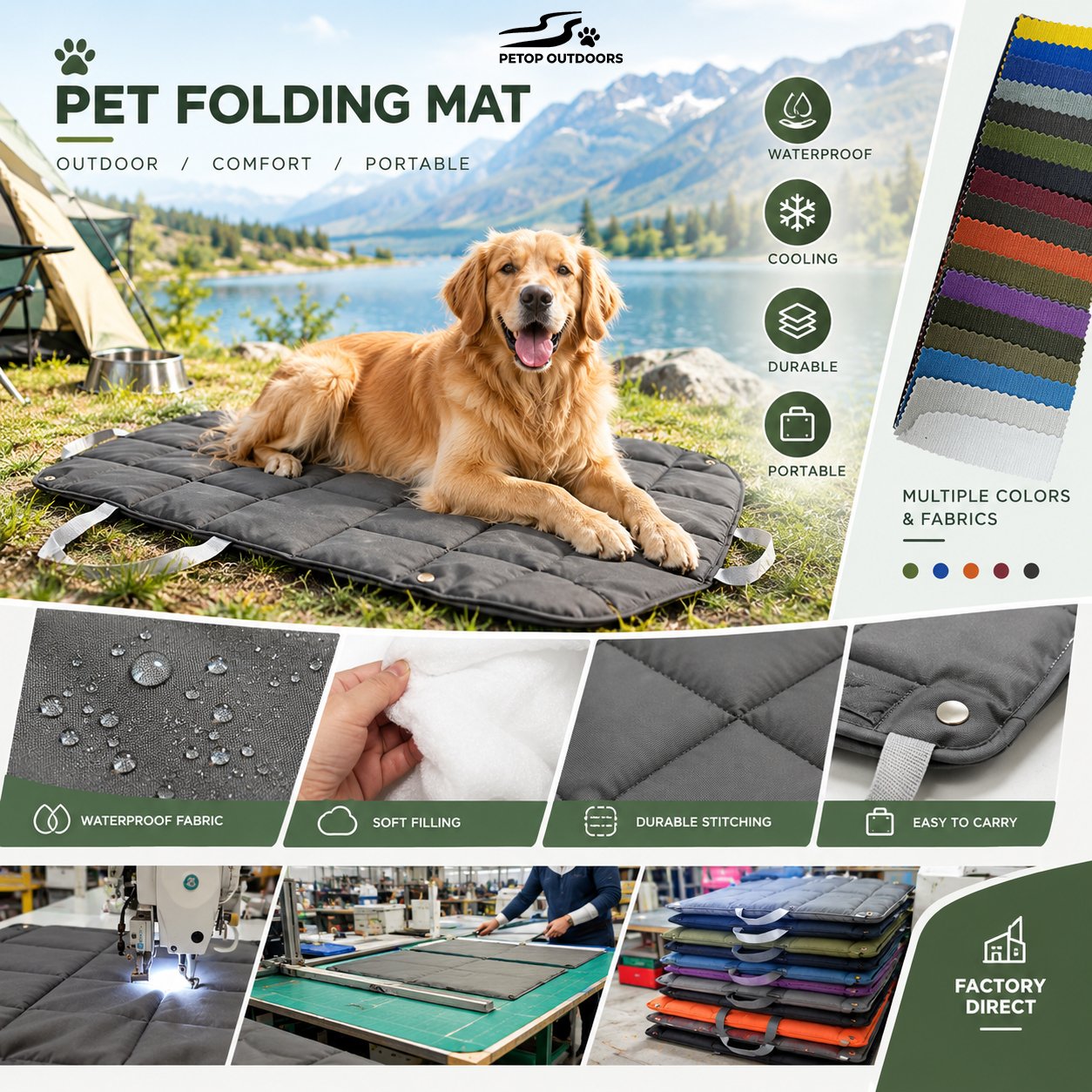
As outdoor lifestyles continue to influence the pet market, more dog owners are taking their pets camping, hiking, road-tripping, RV traveling, and spending weekends outdoors. This has created growing demand for portable outdoor dog beds, foldable dog beds, and travel dog mats.
For pet brands, developing a foldable dog bed can be an opportunity to add a practical product to an outdoor collection. However, turning a product concept into a functional, production-ready product requires more than simply sending a design to a factory.
A capable dog bed OEM manufacturer needs to understand the product’s intended use, materials, dimensions, folding structure, branding requirements, and target cost from the beginning.
So, what information should you prepare when developing a custom outdoor dog bed?
1. Tell Your Manufacturer How the Dog Bed Will Be Used
The intended application is one of the most important starting points.
A dog bed designed for camping and hiking may need to prioritize lightweight construction, portability, durability, and water resistance. A bed designed for RV travel or everyday outdoor use may focus more on comfort, easy cleaning, and a larger sleeping area.
Before sampling, tell your manufacturer:
- Where the product will be used
- The expected outdoor environment
- Target dog size or weight
- Whether it needs to be waterproof or water-resistant
- How frequently it will be folded and transported
- Whether it will be used indoors as well as outdoors
At Petop Outdoors, we review the intended application before recommending materials and construction. This helps connect the product design with its actual use case.
2. Provide the Basic Product Specifications
You do not necessarily need a complete tech pack to start an OEM project.
Even a basic product concept can give the manufacturer enough information to begin a discussion.
Useful specifications include:
- Open dimensions
- Folded dimensions
- Recommended dog size
- Target product weight
- Fabric preference
- Padding or filling preference
- Folding method
- Carrying handle or strap
- Logo placement
- Color or Pantone reference
- Target quantity
- Target price range
A reference image, sketch, CAD drawing, existing sample, or tech pack can all be useful starting points.
If some specifications are not finalized, an experienced manufacturer should be able to identify the missing information and discuss practical solutions with you.
3. Choose Materials According to Outdoor Performance
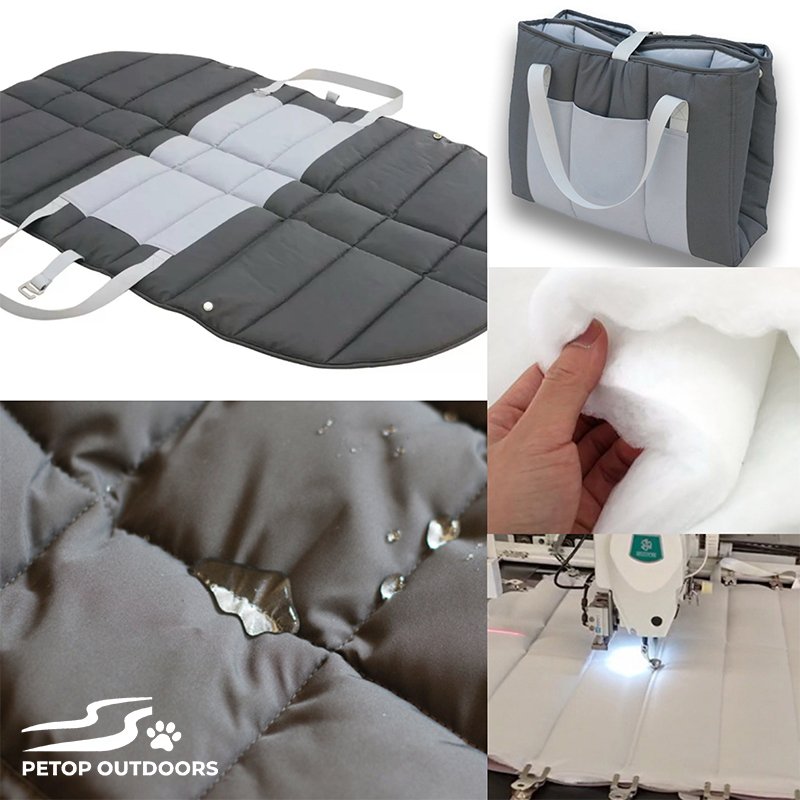
Material selection has a major impact on the performance, appearance, cost, and durability of a foldable dog bed.
Depending on the design and market positioning, manufacturers may use materials such as:
- 600D or 900D Polyester Oxford fabric
- Cordura-style Nylon outdoor fabrics
- Nylon Taslan fabrics
- UV-resistant Textilene mesh
- Resin-bonded cotton Foam or other suitable padding materials
- Water-repellent treated fabrics
- Waterproof coated fabrics
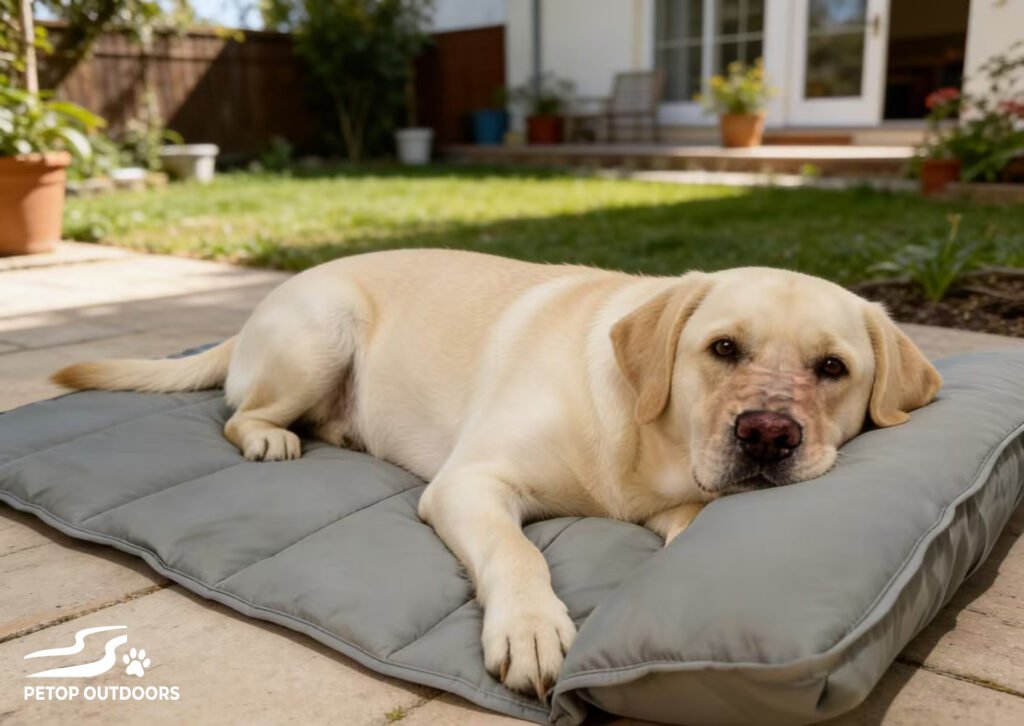
The best material is not necessarily the most expensive material.
For example, a lightweight travel mat may require a different construction from a heavily padded camping dog bed. The manufacturer should consider abrasion resistance, comfort, water resistance, weight, folding performance, cleaning, and target cost together.
At Petop Outdoors, we can evaluate your requested materials and suggest alternative solutions when a specified material is difficult to source, has a high MOQ, or does not provide the desired performance.
4. Pay Attention to the Folding Structure
The defining feature of a foldable dog bed is its portability.
A product may look comfortable when fully opened but become impractical if it is too bulky or difficult to fold.
During development, the manufacturer should evaluate:
Open Size → Folded Size → Folding Method → Padding Thickness → Carrying Method → Packaging Volume
These factors are interconnected.
For example, increasing padding may improve comfort but also increase folded volume and shipping costs. Adding a more complex folding structure may improve portability but increase production complexity.
This is why it is useful to involve the OEM manufacturer during the development stage rather than only after the design has been finalized.
5. Consider MOQ and Production Cost Early
For B2B brands, product design and production cost need to be considered together.
The final cost of a custom foldable dog bed can be affected by:
- Fabric and padding materials
- Product dimensions
- Construction complexity
- Number of sewing operations
- Logo and branding method
- Custom colors
- Packaging
- Order quantity
If you already have a target retail price or target factory cost, sharing it with your manufacturer can help the development team recommend more practical materials and construction methods.
At Petop Outdoors, we aim to help customers balance product performance, appearance, manufacturing efficiency, and target cost during development.
6. OEM Customization Should Go Beyond Adding a Logo
For a private-label pet brand, OEM development is not simply putting a logo on an existing product.
A custom outdoor dog bed may require changes to:
- Dimensions
- Folding structure
- Fabric
- Padding
- Color
- Handle design
- Carrying straps
- Logo application
- Woven labels
- Packaging
- Product details
Petop Outdoors supports OEM/ODM development and can work from a basic concept or a detailed tech pack.
Our team can coordinate material selection → prototype development → sample revision → final confirmation → bulk production.
7. Sample Development Is an Important Part of OEM Production
A first prototype is often used to discover problems rather than immediately become the final production version.
During sampling, a brand may find that:
The padding is too thick or too thin
The folded size is larger than expected
The handle needs reinforcement
The fabric is not suitable for the intended environment
The structure needs easier folding
The product weight needs to be reduced
These issues are much easier and less expensive to solve before bulk production.
At Petop Outdoors, we treat sample development as a collaborative process:
Product Concept → Material Selection → Prototype → Testing & Feedback → Revision → Final Sample → Bulk Production
This approach allows brands to refine the product before committing to a larger production run.
8. Work With an OEM Manufacturer That Can Support Your Product Development
When choosing a foldable dog bed manufacturer, price should not be the only consideration.
A useful manufacturing partner should be able to communicate clearly, understand outdoor applications, provide material options, support customization, identify production issues, and maintain consistent quality during bulk manufacturing.
Petop Outdoors specializes in outdoor pet product manufacturing, including foldable dog beds and mats, dog harnesses, collars, leashes, and other outdoor pet gear.
With 11 years of manufacturing experience, we work with B2B pet brands on customized product development from the initial concept through sampling and bulk production.
Develop Your Custom Foldable Dog Bed with Petop Outdoors
Whether you are developing a foldable dog bed for camping, a portable dog mat for road trips, or a custom outdoor pet bed for your private-label collection, the right OEM partner can help turn your idea into a production-ready product.
You do not need to have every detail finalized before starting a conversation.
A reference image, sketch, product idea, dimensions, or tech pack can be enough for our team to begin evaluating the project and discussing suitable materials, construction, customization, and production options.
Have a new outdoor dog bed project? Contact Petop Outdoors and send your concept, let us explore the manufacturing solution with you.
Frequently Asked Questions
1. What information does an OEM manufacturer need to develop a foldable dog bed?
At minimum, provide the intended use, approximate dimensions, target dog size, preferred materials, folding requirements, branding needs, expected quantity, and target price. A reference image, drawing, sample, or tech pack can make development more efficient.
2. Can I develop a custom outdoor dog bed without a complete tech pack?
Yes. A complete tech pack is helpful but not always required for the first discussion. An experienced OEM manufacturer can review your concept or reference images and help define dimensions, materials, construction, and other production details.
3. What materials are commonly used for foldable outdoor dog beds?
Common materials include Polyester Oxford fabrics, Cordura-style Nylon outdoor fabrics, Nylon Taslan fabrics, UV-resistant Textilene mesh, Resin-bonded cotton Foam and water-resistant or waterproof coated fabrics. Material selection depends on the intended use, required durability, comfort, portability, and target cost.
4. What factors affect the cost of a custom foldable dog bed?
Material selection, product size, padding, folding structure, sewing complexity, custom colors, branding, packaging, and order quantity can all affect the final manufacturing cost.
5. How does the sample development process work?
A typical process is concept → material selection → prototype → testing and feedback → revision → final sample → bulk production. The number of sample revisions depends on the product’s complexity and the changes required.
6. Can Petop Outdoors manufacture a custom foldable dog bed for my brand?
Yes. Petop Outdoors supports OEM/ODM development of outdoor dog beds and travel mats. We can work from a concept, reference image, drawing, measurements, existing sample, or tech pack and assist with material selection, prototype development, revisions, branding, and bulk production.